Problem
A fast voice loop can become unsafe when every stage acts implicitly.
Capture, remote transcription, drafting, and playback have different privacy and failure modes. Coupling them hides what left the device and why audio played.
Independent build · Windows voice tooling
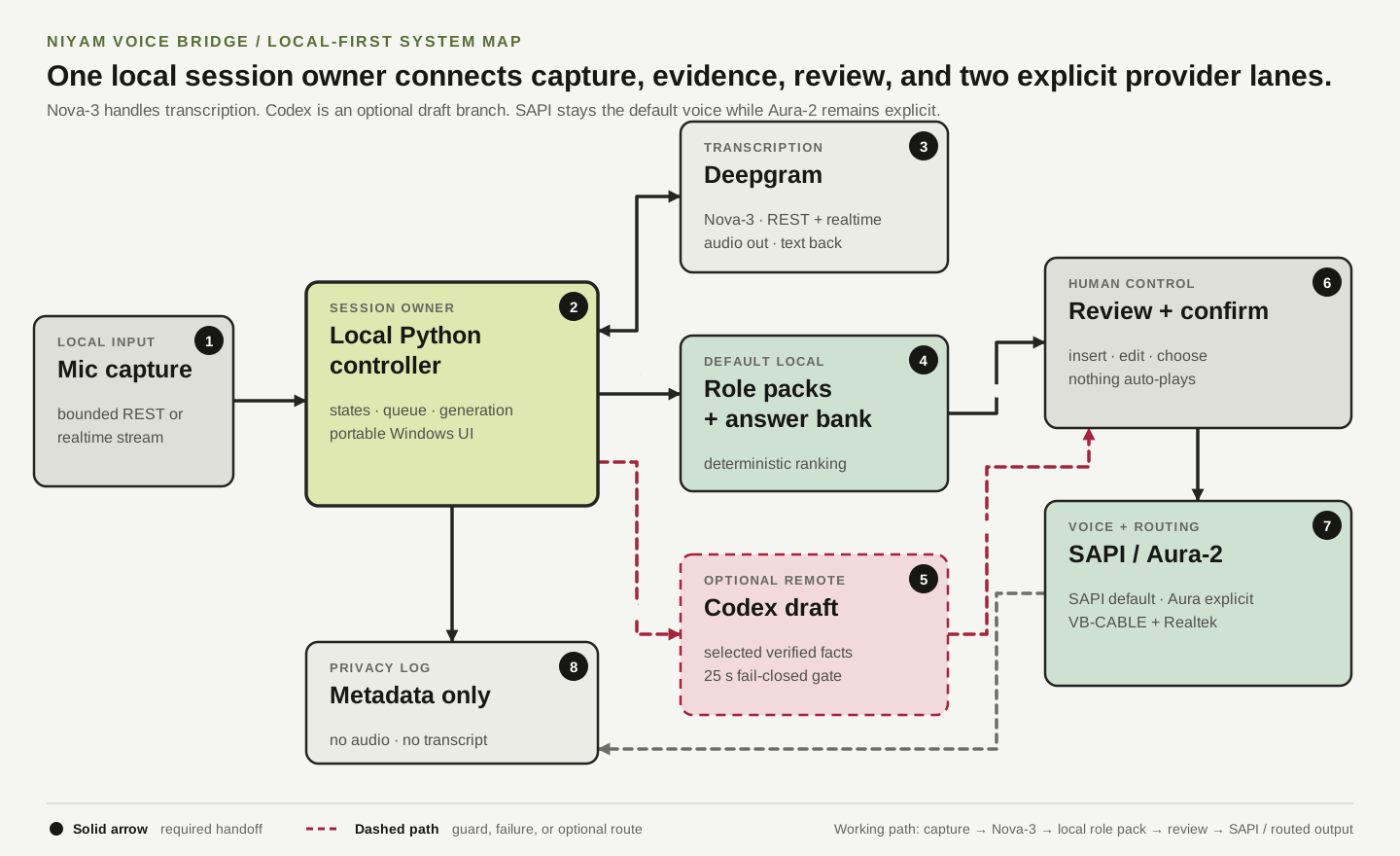
Bounded or realtime capture, Nova-3 transcription, verified role-pack answers, optional grounded drafting, and deliberate SAPI or Aura playback—each kept as a visible action.
Problem
Capture, remote transcription, drafting, and playback have different privacy and failure modes. Coupling them hides what left the device and why audio played.
Build
I separated bounded and realtime capture, Nova-3 transcription, deterministic role-pack ranking, optional grounded Codex drafting, human review, and dual-device Windows playback.
Result
Local matching stays available, drafting fails closed at its latency gate, SAPI remains the default, Aura testing stays explicit, and metadata-only logging excludes content and secrets.
Before / after
answer = remote_draft(question)
play(answer)answer = role_pack.best_match(question)
if operator_requests_draft:
answer = grounded_draft(question, timeout=limit)
play_when_confirmed(answer, voice=selected_voice)Evidence
Stack and capabilities
Next